
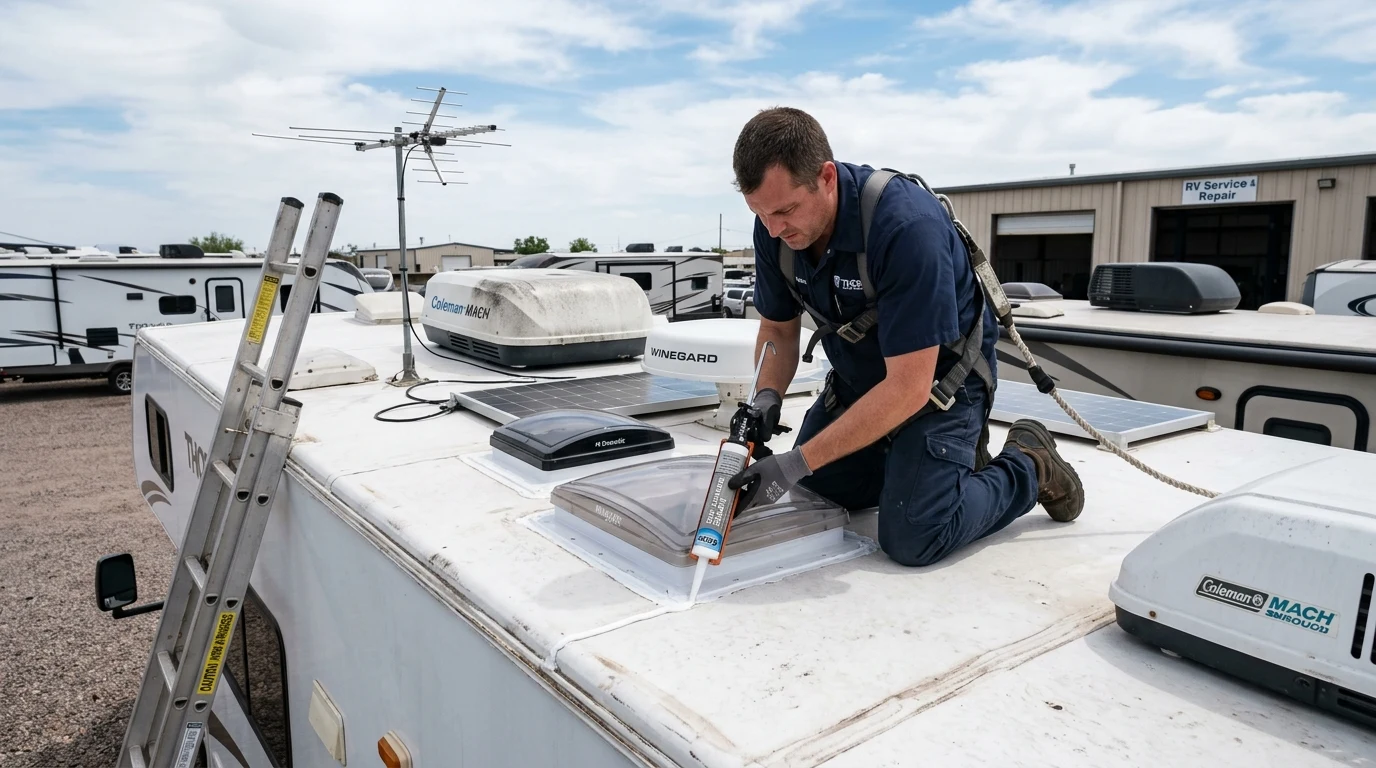
TPO and Fiberglass Roof Seam Maintenance Protocols
Water intrusion through degraded roof seams represents the most catastrophic hazard to Thor motorhomes. Thor roofs feature a thermoplastic polyolefin (TPO) membrane or a one-piece crowned fiberglass shell. While TPO membranes provide puncture resistance and thermal reflectivity, the perimeter seams—including the front cap transition, rear cap seam, Fantastic Vent flanges, plumbing vent stacks, and air conditioner shrouds—require semi-annual inspection.
Never use silicone caulk on an RV roof. Silicone fails to bond chemically to TPO and releases under thermal cycling. The certified factory standard for resealing every TPO Roof Seam is Dicor Lap Sealant (Dicor 501LSW self-leveling) applied across all flat roof transitions. Clean existing sealant thoroughly with mineral spirits to remove road grime, inspect for spiderweb hairline fissures, and apply a continuous bead directly over the existing seam. For permanent long-term repair over longitudinal edge seams, apply 4-inch EternaBond Tape microsealant primed with isopropyl alcohol.
Hydraulic Leveling Jack & Slide-Out Room Maintenance
Thor motorhomes equipped with Lippert Hydraulic Leveling (LCI four-point jacks) require fluid reservoir checks every 6 months with all jacks fully retracted. Fluid must sit within 1/4 to 1/2 inch of the reservoir fill neck. Use only Dexron III or Mercon ATF fluid. For room extension mechanisms, Power Gear Slide-Out systems require quarterly cleaning of wiper seals and dry PTFE lubricant on gear tracks. Never apply grease or WD-40.
For chassis and towing limits, consult the Thor motor coach chassis specifications. For battery maintenance and converter charge profiles, review our transfer switch and battery isolation maintenance guide, or inspect holding tank valve seals using our black and gray waste tank maintenance guide.