
Automatic Transfer Switch (ATS) Diagnostics & Failure Modes
The Automatic Transfer Switch—predominantly the Progressive Dynamics PD52 or Southwire 41260 in Thor motorhomes—safeguards onboard appliances by arbitrating power priority between the 50-amp shore utility power cord and the Cummins Onan generator. By engineering design, generator power takes mechanical priority. When the Onan generator starts and reaches governed frequency (60 Hz at 3,600 RPM for 2-pole units or 1,800 RPM for commercial 4-pole diesels), an internal printed circuit board measures voltage on both L1 and L2 lines before triggering the magnetic contactor coil following a 20-to-30-second delay.
Contactor chatter—characterized by a rapid, loud clicking or buzzing from the ATS enclosure—stems from insufficient coil pull-in voltage. If shore pedestal voltage sags below 102V AC under peak summer air-conditioning loads, the electromagnetic coil lacks sufficient flux to hold the contactor plates firmly closed against internal spring tension. Sustained chatter causes intense electrical arcing across silver-cadmium contacts, carbon pitting, and premature contact welding. Technicians must torque terminal mechanical lugs to exactly 45 lb-in using a calibrated insulated torque screwdriver.
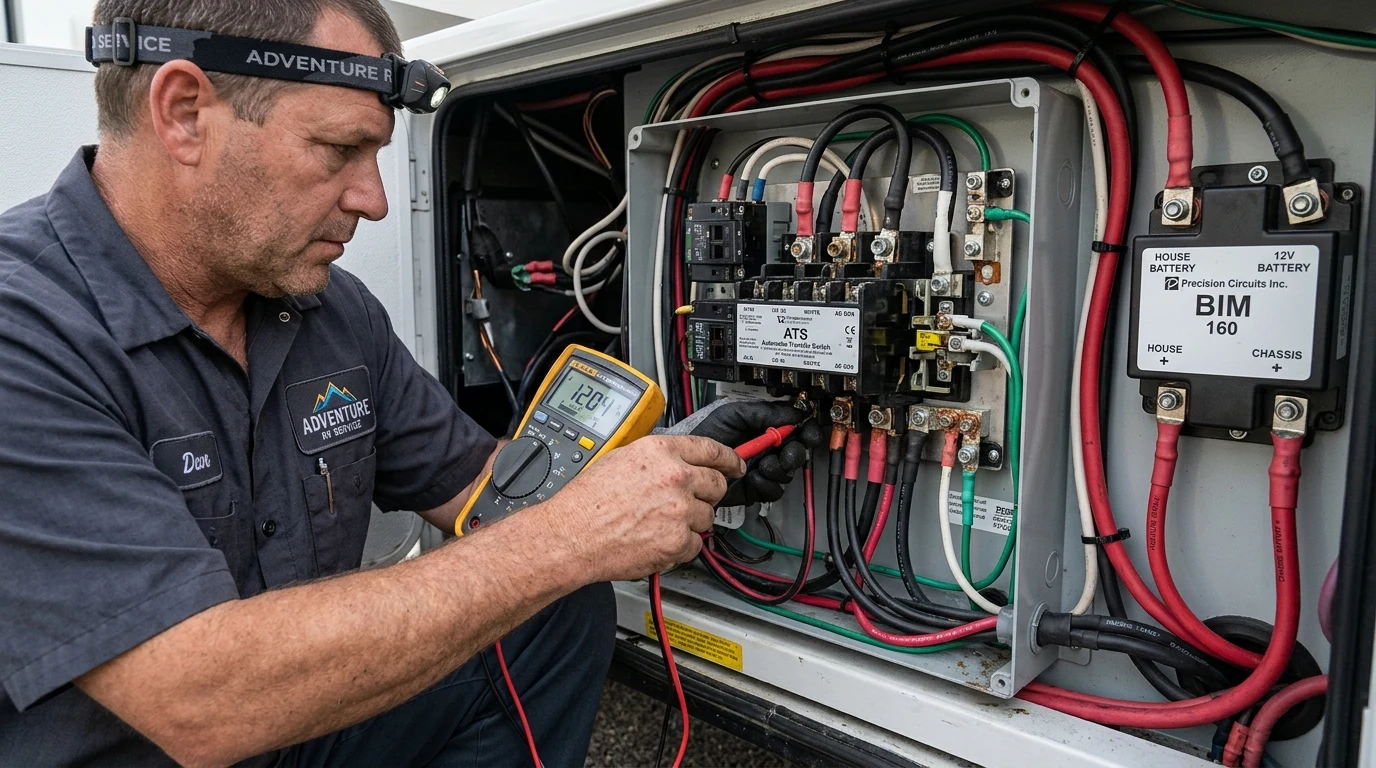
Precision Circuits BIM 160, LiFePO4 Lithium & Voltage Drop Calculations
Thor motorhomes connect the engine alternator to the house living batteries using the Precision Circuits Battery Isolation Manager (BIM 160 on AGM/lead-acid models, Li-BIM 225 on factory lithium packages). The unit features micro-controller logic that continuously monitors chassis battery voltage on Stud A and coach house voltage on Stud B.
During alternator charging, the Li-BIM 225 enforces a protective duty cycle: 15 minutes of continuous charge connection followed by 20 minutes of complete separation. This duty cycle prevents the high acceptance rate of low-impedance LiFePO4 cells from drawing excessive continuous current that would overheat the Ford or Freightliner alternator stator.
Proper cable conductor sizing is critical: to prevent excessive voltage drop on 12V DC high-current circuits, the voltage drop must not exceed 3% under continuous load per ABYC E-11 standards. For a 2,000-watt pure sine wave inverter pulling 170 amps over a 10-foot run, 2/0 AWG or 4/0 AWG pure copper cable is required. Under Peukert's law, while traditional flooded lead-acid batteries exhibit an exponent (k ≈ 1.25) causing drastic capacity loss under high inverter loads, modern LiFePO4 cells maintain a nearly ideal Peukert coefficient (k ≈ 1.04), delivering near 100% rated amp-hour capacity regardless of discharge rate.
To diagnose macerator pump electrical circuits, review the Thor RV plumbing and holding tank monitoring systems. For generator oil specifications and electrical inspection schedules, consult the seasonal RV maintenance schedule and roof specs, or return to the master Thor RV technical specifications hub.